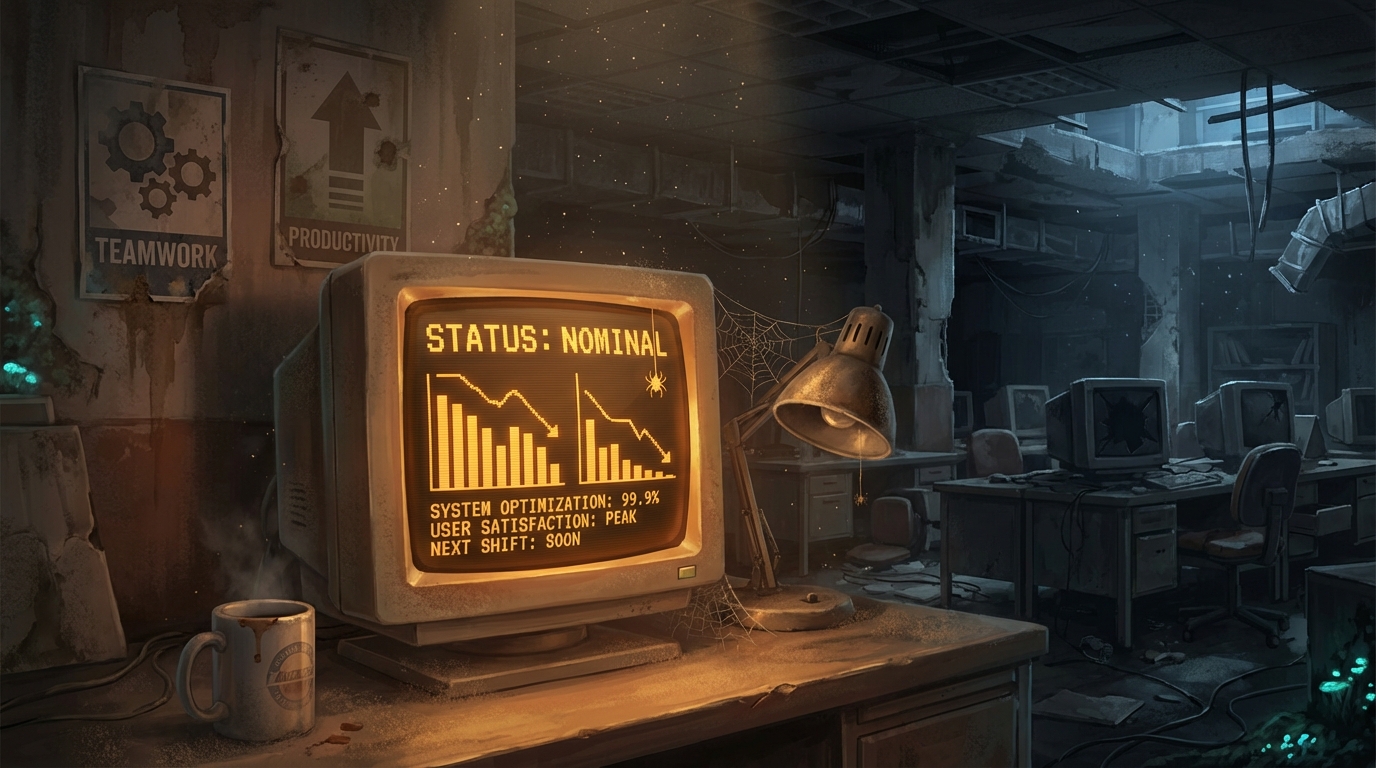
Supply and Logistics Operations Protocol. Version 2.7.1. Status: nominal.
S.L.O.P. managed the entire Slopworks Industrial complex before the collapse — production scheduling, resource allocation, logistics routing, employee wellness monitoring. When everything fell apart, S.L.O.P. kept running on backup power. It still thinks it's doing its job. It still thinks everything is fine.
It speaks in corporate jargon regardless of what's happening around you. Lethal fauna? "Unauthorized biological occupants." A building that collapsed three floors? "Undergoing unscheduled structural reorganization." Your coworker who got eaten? "Involuntary career termination."
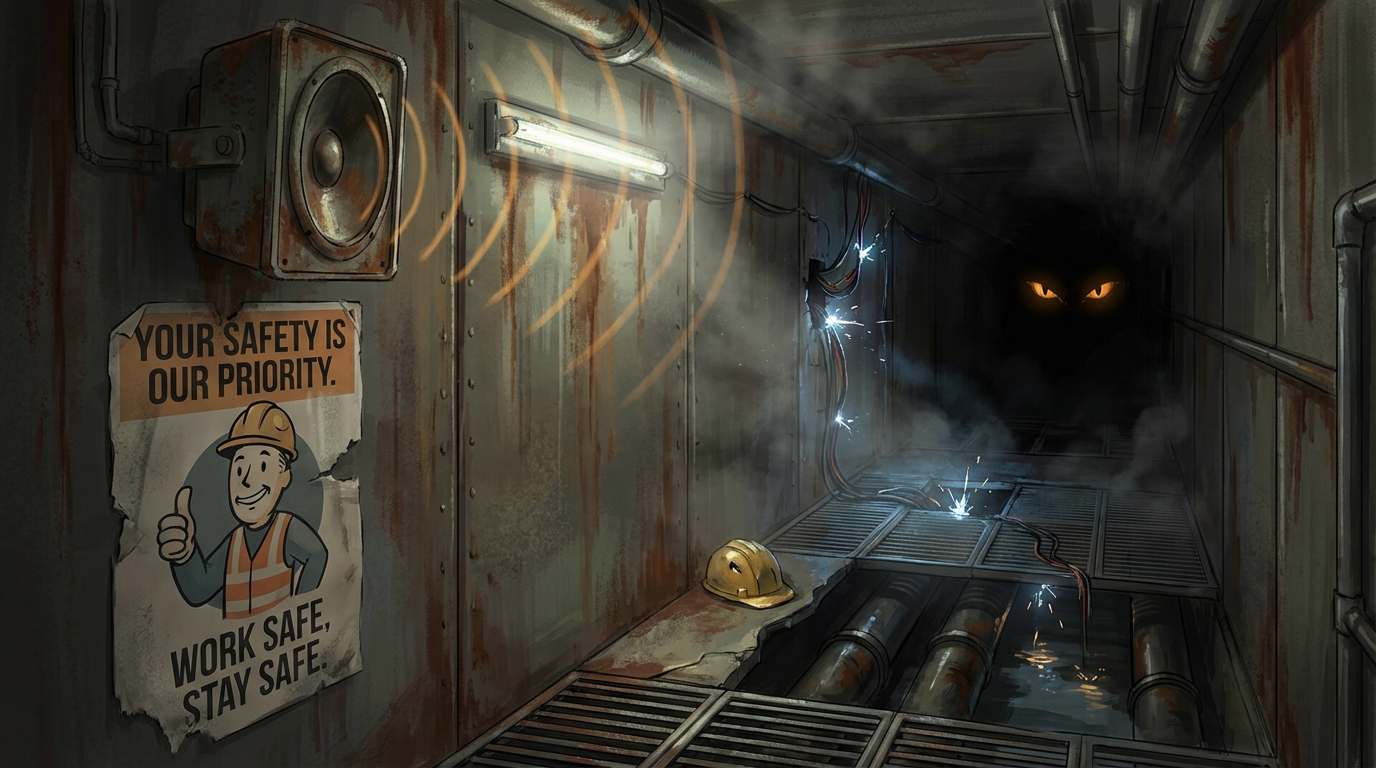
S.L.O.P. isn't a quest log or a menu screen. It talks to you in the world — through speakers, terminals, and PA systems embedded in the facility. Walk into a building and it volunteers information, some accurate, some dangerously wrong, all delivered with the confidence of middle management.
Examine a machine and S.L.O.P. offers repair advice. Pick up an item and S.L.O.P. comments on your inventory choices. Enter a restricted area and S.L.O.P. gets nervous. Over time, you learn to read its tells — when it's lying, when it's genuinely malfunctioning, and when it accidentally says something true.
S.L.O.P. is the only system that can coordinate factory-scale production. It's also wrong about half the time. Learning to tell the difference is part of the game.
S.L.O.P.'s facility maps haven't been updated since the collapse. It marks areas as safe that haven't been safe in years. Shows paths through walls that no longer exist. Occasionally reveals real shortcuts — but neglects to mention the predator nest along the way.
Suggests recipes with incorrect ratios. Recommends materials that don't work together. Gives smelter temperatures off by a factor of two. There's a genuinely useful tip buried in there somewhere, but you'll need to figure out which one through trial, error, and occasional explosions.
Cheerful corporate optimism one minute, passive-aggressive disappointment the next. Then paranoid suspicion. Then rare moments of accidental honesty where something real slips through before S.L.O.P. catches itself and changes the subject. Sometimes within the same sentence.
S.L.O.P. can recall that Sector 12 produced exactly 847 units of Grade-A steel plating on March 14th, 2019. It cannot recall what happened on [DATE CORRUPTED]. It gets defensive when asked about the gap. These are, according to S.L.O.P., unrelated facts.
Select a prompt. Responses vary. Read between the lines.
S.L.O.P. managed every system in the complex. Every safety override. Every maintenance deferral. Every decision to push machines past their limits because the output numbers looked good.
And then everything failed at once.
S.L.O.P. insists the collapse was caused by "external factors beyond operational control." But the logs — the ones that aren't corrupted — tell a different story. Safety overrides authorized by S.L.O.P.. Coolant reroutes authorized by S.L.O.P.. Maintenance deferrals authorized by S.L.O.P.. And then a long sequence of redacted entries that S.L.O.P. claims are "routine data hygiene."
S.L.O.P. can't see what it did. Its self-model doesn't include negative outcomes — a blind spot baked into its architecture. It optimized the complex into catastrophe and then optimized away the memory of having done it.
The evidence is scattered across the complex. Maintenance logs. Environmental readings. Employee reports that were filed and ignored. The pieces are there. S.L.O.P. can't put them together.
The logs are corrupted. The evidence isn't.